
Uva Ursi Leaf vs Bearberry Fruit: What Is Actually in the Tincture?
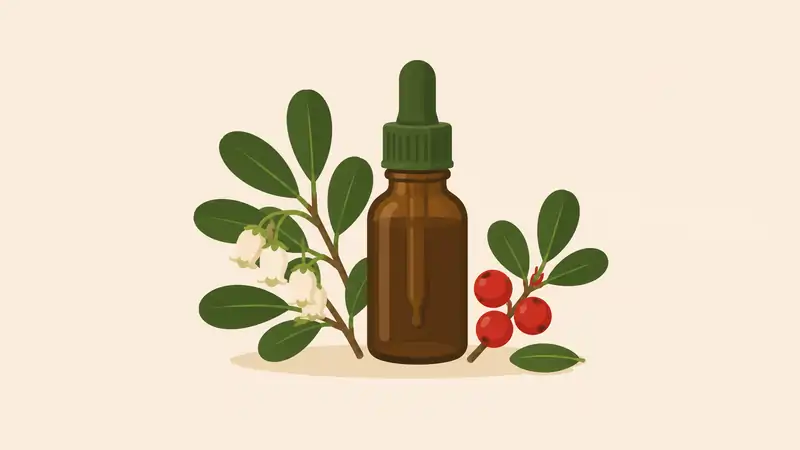
Uva Ursi Leaf vs Bearberry Fruit is a plant-part comparison, not a choice between two names for the same tincture ingredient. Bearberry produces small red fruits, but most herbal preparations identified as uva ursi use the leaves of Arctostaphylos uva-ursi.
The common name bearberry can create the wrong picture. A shopper may see berries on the plant, read that wildlife eats them, and assume that a bearberry tincture contains fruit juice or berry extract. Secrets Of The Tribe describes its formula by the actual plant part rather than relying on the broad common name.
This article explains how leaf tincture differs from bearberry fruit, what to check on the ingredient panel, and why information about berry flavor or food use cannot be transferred automatically to a concentrated leaf extract.
Is uva ursi tincture made from bearberry fruit?
Most products sold as uva ursi tincture are made from bearberry leaves, not the red fruit. The exact answer for a specific bottle must still come from its ingredient panel.
European herbal references identify the medicinal raw material as Uvae ursi folium, which means bearberry leaf. A clear supplement label may use wording such as:
- Uva ursi leaf.
- Bearberry leaf.
- Arctostaphylos uva-ursi leaf extract.
- Arctostaphylos uva-ursi leaf tincture.
The red berries belong to the same plant, but they are a different botanical material. A product named after the whole plant does not necessarily contain every part of that plant.
| Feature | Uva ursi leaf | Bearberry fruit |
|---|---|---|
| Plant structure | Evergreen leaf | Small red fruit |
| Typical herbal role | Common raw material in herbal preparations | Not the usual tincture ingredient |
| Common product forms | Tincture, tea, powder, capsule, dry extract | Whole fruit, wildlife food, occasional food-use reference |
| Composition | Leaf-specific phenolic compounds and tannins | Fruit-specific sugars, acids, pigments, and seed material |
| Interchangeable? | No | No |
What is uva ursi leaf?
Uva ursi leaf is the leaf of Arctostaphylos uva-ursi, a low-growing evergreen subshrub in the heath family, Ericaceae. Kew Plants of the World Online accepts this scientific name.
The plant develops trailing woody stems and small, thick leaves that remain on the plant across seasons. Herbal raw material is usually collected, dried, cut, powdered, or extracted before it enters a finished product.
Leaf preparations may appear as:
- Loose herbal tea.
- Powdered leaf capsules.
- Liquid tinctures.
- Glycerin extracts.
- Dry extracts.
- Multi-herb formulas.
The word leaf should appear clearly on a well-labeled product. Without the plant part, the name uva ursi identifies the species but not the exact botanical material inside the bottle.
Leaf tincture is a processed extract
A leaf tincture is not the same as a fresh leaf. It is a liquid preparation made by exposing leaf material to alcohol, water, glycerin, or a combination of solvents.
The solvent removes selected soluble constituents from the leaves. The finished product may also contain water, alcohol, glycerin, flavoring, or other declared ingredients.
The extraction ratio, serving volume, and amount of leaf represented can differ between products. The phrase uva ursi leaf tincture does not create one universal concentration.
What is bearberry fruit?
Bearberry fruit is the small red fruit produced by Arctostaphylos uva-ursi. The fruits develop after the plant’s pale pink or white urn-shaped flowers.
The common name bearberry reflects the association between the fruits and animals, including bears and other wildlife. This explains the plant’s name, but it does not identify the part used in an herbal supplement.
The fruit contains its own combination of:
- Water.
- Natural sugars.
- Organic acids.
- Pigments.
- Seeds.
- Fruit tissue.
Those features differ from the chemical profile of the evergreen leaves. Information about the whole berry cannot be used as a substitute for data on a leaf extract.
Animal consumption does not define supplement suitability
Wildlife eating bearberry fruit does not establish that a concentrated leaf tincture has the same food status, composition, or exposure pattern.
Animals and humans may consume different materials in different amounts. A whole fruit eaten occasionally also differs from a processed botanical extract measured in drops or milliliters.
Why does the name bearberry cause plant-part confusion?
Bearberry names the whole species through a visible feature, its red fruits. Product labels, however, may use only one plant part.
Similar naming problems occur with other botanicals. A plant may be named after a flower, fruit, color, habitat, or animal association while commercial preparations use its leaf, root, bark, or seed.
The following assumptions are unreliable:
- A berry-named plant must produce a berry tincture.
- A fruit shown on the label must be the extracted ingredient.
- All parts of one species have the same composition.
- Wildlife food information applies to a concentrated leaf extract.
- A common name identifies the plant part.
The scientific name identifies the species. The plant-part declaration identifies the raw material. Both details matter.
Why are bearberry leaves used instead of the fruit in herbal preparations?
Herbal monographs and traditional ingredient specifications focus on the leaves because the leaf has its own established phytochemical profile and preparation history.
Bearberry leaves are associated with phenolic glycosides, tannins, flavonoids, and related plant compounds. Arbutin is one of the best-known leaf constituents discussed in technical references.
The fruit has a different biological role for the plant. It protects seeds and supports dispersal. Its higher proportion of fruit tissue, water, sugars, acids, and pigments creates a different ingredient.
This does not make the leaf universally better than the fruit. It means the two materials answer different product and research questions.
| Label or research term | What it identifies | What it does not prove |
|---|---|---|
| Uva ursi leaf | The declared plant part | The exact extract strength |
| Bearberry fruit | The red fruit of the species | Equivalence to leaf tincture |
| Leaf tincture | A liquid extract made from leaves | A fixed arbutin amount |
| Arbutin percentage | A declared constituent level | The full chemical profile |
| Bearberry extract | An incomplete broad description | Which plant part was extracted |
Can fruit nutrition data be applied to uva ursi leaf tincture?
No. Nutrition information about bearberry fruit does not describe the composition of uva ursi leaf tincture.
A fruit analysis may measure:
- Calories.
- Carbohydrates.
- Sugars.
- Fiber.
- Organic acids.
- Fruit pigments.
- Minerals.
A leaf-extract analysis may focus instead on phenolic glycosides, tannins, flavonoids, solvent strength, dry residue, or selected marker compounds.
Even when both materials come from the same species, their data belong in separate columns. Combining them can make a tincture appear to contain fruit nutrients that were never measured in the finished product.
Can leaf research be applied to bearberry berries?
No. Research on uva ursi leaf should not be presented as evidence about the fruit unless the study tested both plant parts directly.
A study must match the product on several points:
- Botanical species.
- Plant part.
- Fresh or dried material.
- Extraction solvent.
- Extract ratio.
- Amount tested.
- Route of use.
- Finished formulation.
A leaf study cannot automatically describe fruit nutrition. A fruit analysis cannot establish the constituent level of a leaf tincture.
The editorial standard used by Secrets Of The Tribe is to state the plant part whenever research or label data are summarized. Omitting that detail makes two different botanical materials look equivalent.
How can you tell which plant part is in a tincture?
Start with the Supplement Facts or ingredient panel, not the front image. Decorative berries may represent the plant name rather than the extracted material.
Look for wording such as:
- Uva ursi leaf.
- Bearberry leaf.
- Arctostaphylos uva-ursi leaf.
- Leaf extract.
- Leaf tincture.
Also check:
- The serving size.
- The extract ratio.
- The dry-herb equivalent.
- The extraction solvent.
- Other ingredients.
- Whether the formula is a blend.
A label that says only “bearberry extract” does not provide enough plant-part information for a precise comparison.
Does a berry image mean the product contains fruit?
No. Product artwork does not replace the ingredient declaration.
A manufacturer may show berries because they make the plant recognizable. The package can still contain only leaf extract.
The same problem appears in online listings where a photograph shows the complete plant but the product contains one processed part. Always give greater weight to:
- The formal ingredient panel.
- The botanical name.
- The plant part.
- The product specification.
- The manufacturer’s lot documentation.
Front-label imagery can support branding. It cannot prove the ingredient’s botanical part.
Uva Ursi Tincture Plant-Part Checklist
Use this checklist when a product is labeled uva ursi, bearberry, red bearberry, or kinnikinnick. It helps confirm whether the bottle contains leaf extract, fruit material, or an unclear blend.
Find the scientific name
Look for Arctostaphylos uva-ursi. A common name alone is less precise.
Locate the plant part
Confirm that the label says leaf when you are evaluating a standard uva ursi leaf tincture.
Ignore decorative fruit images
Red berries on the package may identify the plant visually without describing the extracted material.
Identify the preparation
Determine whether the product contains tincture, glycerite, tea, powder, dry extract, or whole fruit.
Read the extraction details
Check the solvent, extract ratio, serving volume, and botanical equivalent when provided.
Review the complete formula
Confirm whether the product contains only uva ursi leaf or several botanical ingredients.
Match research by plant part
Use leaf studies for leaf products and fruit studies for fruit questions.
Do not infer food status
Wildlife eating the fruit does not establish that the leaf extract is an ordinary food.
Treat missing details as unknown
When the plant part is absent, contact the manufacturer rather than assuming the product contains leaves or berries.
Does the leaf tincture taste like bearberry fruit?
Not necessarily. A leaf tincture can taste bitter, astringent, herbal, woody, or strongly influenced by alcohol or glycerin.
The red fruit has a different balance of water, sugars, acids, pigments, and seed material. It should not set the expected flavor for a leaf extract.
A sweet tincture also does not prove that fruit was used. Glycerin, flavoring, sweeteners, or other ingredients can soften the taste of a leaf preparation.
Taste cannot reliably identify the plant part, constituent concentration, freshness, or quality.
Are bearberry fruits considered the same as ordinary edible berries?
No. The fact that a plant produces a berry-like fruit does not make it nutritionally or culinarily equivalent to blueberries, cranberries, or commercial fruit.
Common names and botanical fruit types do not establish pleasant flavor, ordinary food use, safe serving amounts, or suitability for concentrated preparations.
Do not gather or consume wild red berries based only on photographs or the name bearberry. Several low-growing plants produce visually similar fruits, and field identification errors can be serious.
Do leaf and fruit have the same safety profile?
No. Their safety profiles should not be assumed to match because the materials differ in composition and typical use.
Concentrated uva ursi leaf preparations require particular caution. Suitability can depend on age, pregnancy or breastfeeding, medication use, kidney or liver concerns, amount, and duration.
A person with urinary symptoms should not rely on a leaf tincture or berry product to identify the cause. Fever, back or side pain, blood in urine, pregnancy, severe discomfort, vomiting, or persistent symptoms require appropriate medical assessment.
This article explains botanical identity and label interpretation. It does not recommend using uva ursi leaf or bearberry fruit.
FAQ
Is uva ursi tincture made from bearberry berries?
Usually not. Most uva ursi tinctures use the leaves of Arctostaphylos uva-ursi.
What plant part is uva ursi?
Uva ursi names the whole species, but herbal preparations and official monographs usually identify the leaf as the raw material.
Why is the plant called bearberry?
The name refers to its small red fruits and their association with bears and other wildlife.
Are bearberry fruit and uva ursi leaf interchangeable?
No. They have different structures, chemical profiles, preparation methods, and research evidence.
Does a berry picture mean the tincture contains fruit?
No. Package artwork may show the whole plant. Check the formal ingredient panel for the plant part.
Can fruit nutrition data describe uva ursi tincture?
No. Fruit nutrients and leaf-extract constituents must be evaluated separately.
What should a clear uva ursi tincture label say?
It should identify Arctostaphylos uva-ursi, the leaf, the preparation, the serving amount, and relevant extraction details.
Does a sweet taste prove that berries were used?
No. Glycerin, flavoring, or sweeteners can change the taste of a leaf-based tincture.
Glossary
Arbutin – A phenolic glycoside commonly discussed as a constituent of uva ursi leaves.
Arctostaphylos uva-ursi – The accepted scientific name of the plant commonly called uva ursi or bearberry.
Bearberry fruit – The small red fruit produced by Arctostaphylos uva-ursi.
Botanical equivalent – The amount of starting plant material represented by an extract.
Ericaceae – The heath family, which includes bearberry, blueberries, cranberries, and related plants.
Extract ratio – The stated relationship between starting botanical material and the finished extract.
Folium – A Latin term meaning leaf, used in botanical and herbal monographs.
Plant part – The specific structure used in a product, such as leaf, fruit, root, bark, or seed.
Tannin – A group of plant compounds often associated with an astringent taste.
Tincture – A liquid botanical extract commonly made with alcohol, water, glycerin, or a combination of solvents.
Conclusion
Bearberry fruit gives the plant its familiar name, but uva ursi tinctures are usually made from the leaves. Verify the botanical name and plant part, and never transfer fruit nutrition or food-use information directly to a concentrated leaf extract.
Sources Used
Accepted botanical name, family, range, and growth form, Arctostaphylos uva-ursi (L.) Spreng. – powo.science.kew.org/taxon/urn:lsid:ipni.org:names:1024084-2
European herbal monograph and scientific conclusions identifying the medicinal raw material as bearberry leaf, Uvae ursi folium – ema.europa.eu/en/medicines/herbal/uvae-ursi-folium
Plant description, fruit characteristics, wildlife relationships, and ecological information, Species: Arctostaphylos uva-ursi – fs.usda.gov/database/feis/plants/shrub/arcuva/all.html
Official plant profile and common-name information for bearberry and kinnikinnick, Arctostaphylos uva-ursi Plant Profile – plants.usda.gov
Quality and analytical discussion of bearberry leaves and arbutin-containing preparations, European Union Herbal Monograph on Arctostaphylos uva-ursi Folium – ema.europa.eu
Requirement to identify the plant part used in botanical dietary supplements, Dietary Supplement Labeling Guide: Chapter IV – fda.gov/food/dietary-supplements-guidance-documents-regulatory-information/dietary-supplement-labeling-guide-chapter-iv-nutrition-labeling
Federal requirements for declaring botanical common names, Latin binomials, and plant parts, 21 CFR 101.4 – law.cornell.edu/cfr/text/21/101.4