
Scouts Still Need Eyes; Data Decides Where They Look
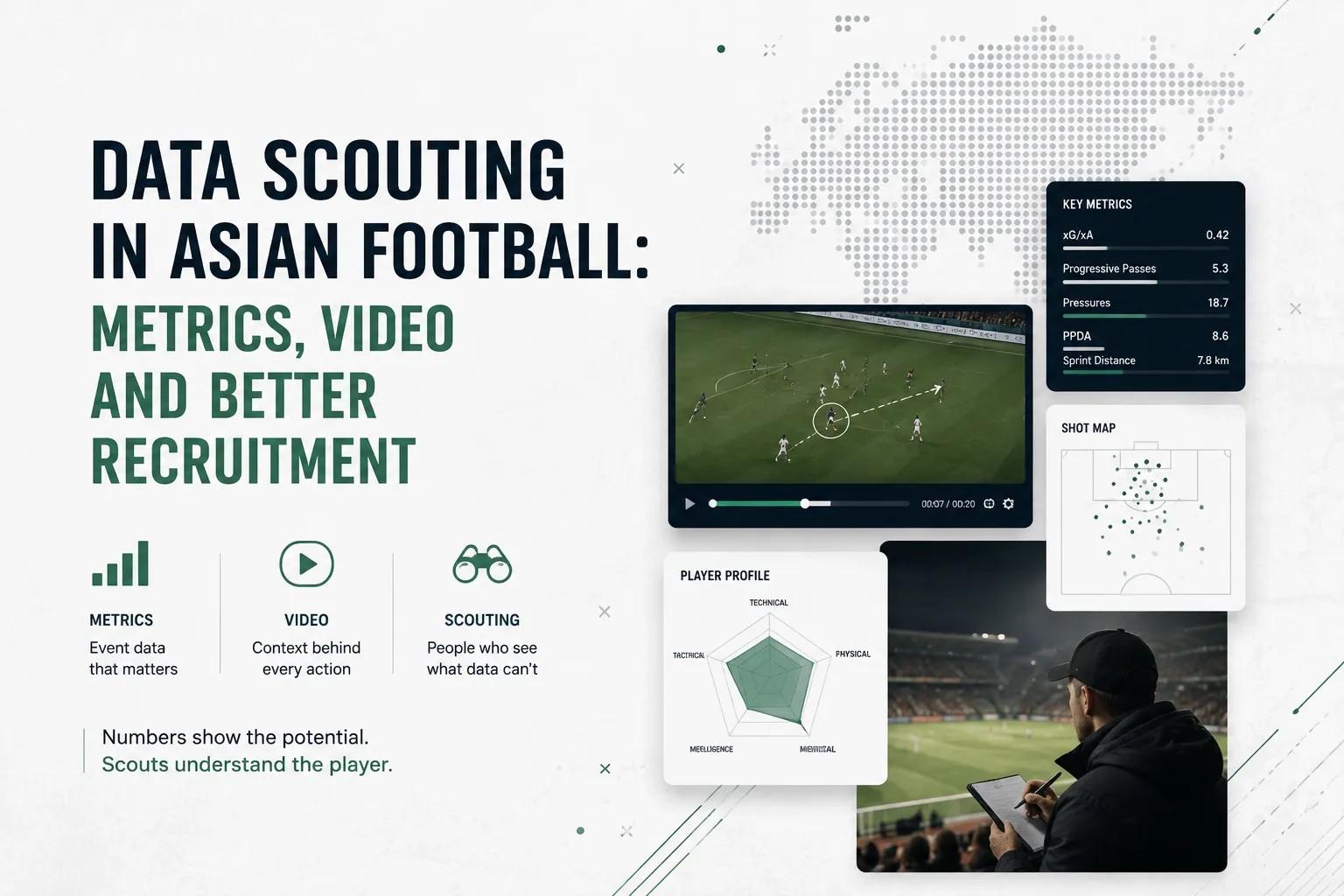
The old recruitment bottleneck was access. A club could not send enough scouts across Japan, Indonesia, Korea, Australia, Central Asia and the Gulf to watch every plausible target. Video and data now let one department reduce thousands of players to a workable list before anyone books a flight.
That change does not make the highest-rated player the best signing. Asian leagues differ in pace, schedule, climate, tactical style and data coverage. A model can find an unusual full-back in minutes; it still needs a scout to explain whether his numbers travel.
Start With the Job, Not the Database
A recruitment brief should describe actions rather than labels. “Right-back” is too broad when one coach wants an overlapping runner and another needs an inverted midfielder who can defend transitions. Age range, preferred foot, salary band, registration status and contract timing narrow the search before performance metrics enter it.
The first filter then becomes position-specific. A centre-back may be screened for aerial involvement, progressive passing and space defended behind the line. A winger’s shortlist could use carries into the box, receiving location, chance creation and defensive work, all adjusted for minutes and team possession.
65%: A Warning, Not a Victory Lap
FIFA’s talent-development review found that 85% of the top 20 member associations had qualified scouts and talent-identification staff, while 65% had an IT system or database for talent identification. The gap matters. Technology can widen coverage, but coverage alone does not create a shared definition of potential.
The AFC Coaching Convention reflects that broader skill set. Its curriculum connects scouting networks with football data, psychological testing, performance indicators and staff judgement. A database is one instrument inside the process, not the department itself.
Access Speed Cannot Repair Old Information
Recruitment teams work across video platforms, registration records, spreadsheets and live reports, which makes account security part of daily operations. The same principle applies when supporters prepare access before a match rather than during a rumour spike. Completing 1xBet login does not give an unconfirmed transfer more authority. Every market view still needs to be checked against a dated club announcement, competition record or federation document. Speed is useful only after verification.
Freshness is especially important around loans and youth promotions. A role can change within weeks when a coach moves a player inside, alters the press or gives him set-piece responsibility. Season totals may then combine two jobs that should be analysed separately.
Three Screens, Three Answers
Event data records actions around the ball: passes, shots, pressures, tackles and carries. Tracking data follows positions and movement, revealing spacing, runs without the ball and recovery speed. Video supplies the sequence that explains why an action occurred.
None should be treated as a substitute for the others. A low passing volume may reflect a team that bypasses midfield, not a player hiding from possession. High pressing numbers can come from a broken structure that forces repeated emergency actions.
Make the Shortlist Portable
Software used on a scouting trip should be installed and tested before the first stadium visit. Offline notes, battery use, permissions and file storage matter when a ground has weak connectivity. The 1xBet download option belongs to a separate technical check for users following fixtures and markets, not to the evaluation of a player. Recruitment evidence remains inside match footage, verified data and direct observation. A weak signal should not decide which evidence survives.
A portable shortlist contains clips tied to claims. If a report says a midfielder scans before receiving, show several possessions against different opponents. If it says he protects the ball under pressure, include failed actions too; edited success reels hide the error rate a buying club must price.
Can the Numbers Survive a League Change?
Raw percentiles assume that competitions are comparable. They are not. A striker taking six shots per 90 for a dominant club may receive fewer usable chances after moving, while a defender in a low block can accumulate clearances that disappear in a possession-heavy team.
Good models adjust for team strength, possession, opponent quality, game state and role. Scouts then test the output against matches where the player faced the style expected at the destination club. Translation is a football question before it becomes a mathematical one.
Randomness Is Not a Scouting Metric
Small football samples contain noise, but the match still has causes: tactics, opponents, injuries and decisions. Casino software operates on a different mechanism. A demo slot can expose rules, paylines and feature frequency without risking funds, yet its practice balance cannot forecast the next generated result. Treating a player’s ten-match run as equivalent randomness would discard the context scouts are paid to investigate. The scout still has to explain the football.
Sample size still deserves discipline. One hot finishing month should be compared with shot locations, expected goals and the player’s longer record. The aim is not to remove judgement; it is to show exactly where judgement is carrying more weight than evidence.
Inside the Final Live Visit
Data makes the final stadium visit more focused. The scout can watch communication, reactions after mistakes, movement outside the broadcast frame and behaviour when the player is not involved. Those observations are difficult to reduce to a reliable public metric.
FIFA recorded 86,158 international transfers across professional and amateur football in 2025, with men’s professional fees reaching USD 13.08 billion. In a market that large, Asian clubs and players gain visibility when structured data lowers the cost of the first look. The recruitment edge comes from rejecting false positives before the medical, contract and registration work begins.