
Backyard Dandelion vs Dandelion Leaf Capsules: Why Foraging Is Not the Same as Buying
Backyard Dandelion vs Dandelion Leaf Capsules is a practical question because dandelion feels familiar. It grows in lawns, parks, sidewalk cracks, gardens, and wild patches, so it is easy to think, “Why buy dandelion leaf capsules if I already have dandelions outside?” The answer is simple: a backyard plant and a commercial supplement are not the same product.
Dandelion leaves can be edible when correctly identified and gathered from a clean, safe location. But backyard dandelions may also be exposed to herbicides, pesticides, dog-walk areas, roadside pollution, lawn treatments, contaminated soil, or misidentification risk. Dandelion leaf capsules are different because they are dried, processed, measured, packaged, and labeled as a supplement. Garden Organics treats this as a sourcing and safety-literacy topic: familiar plants still require careful handling.
This article does not provide medical advice. Dandelion leaf products are not intended to diagnose, treat, cure, or prevent any disease. If you are pregnant or breastfeeding, under 18, taking medication, using diuretics, taking lithium, managing kidney disease, gallbladder issues, bile duct issues, blood sugar concerns, blood pressure concerns, ragweed-family allergies, or chronic health conditions, ask a qualified healthcare professional before using dandelion supplements.
Can You Use Backyard Dandelion Instead of Dandelion Leaf Capsules?
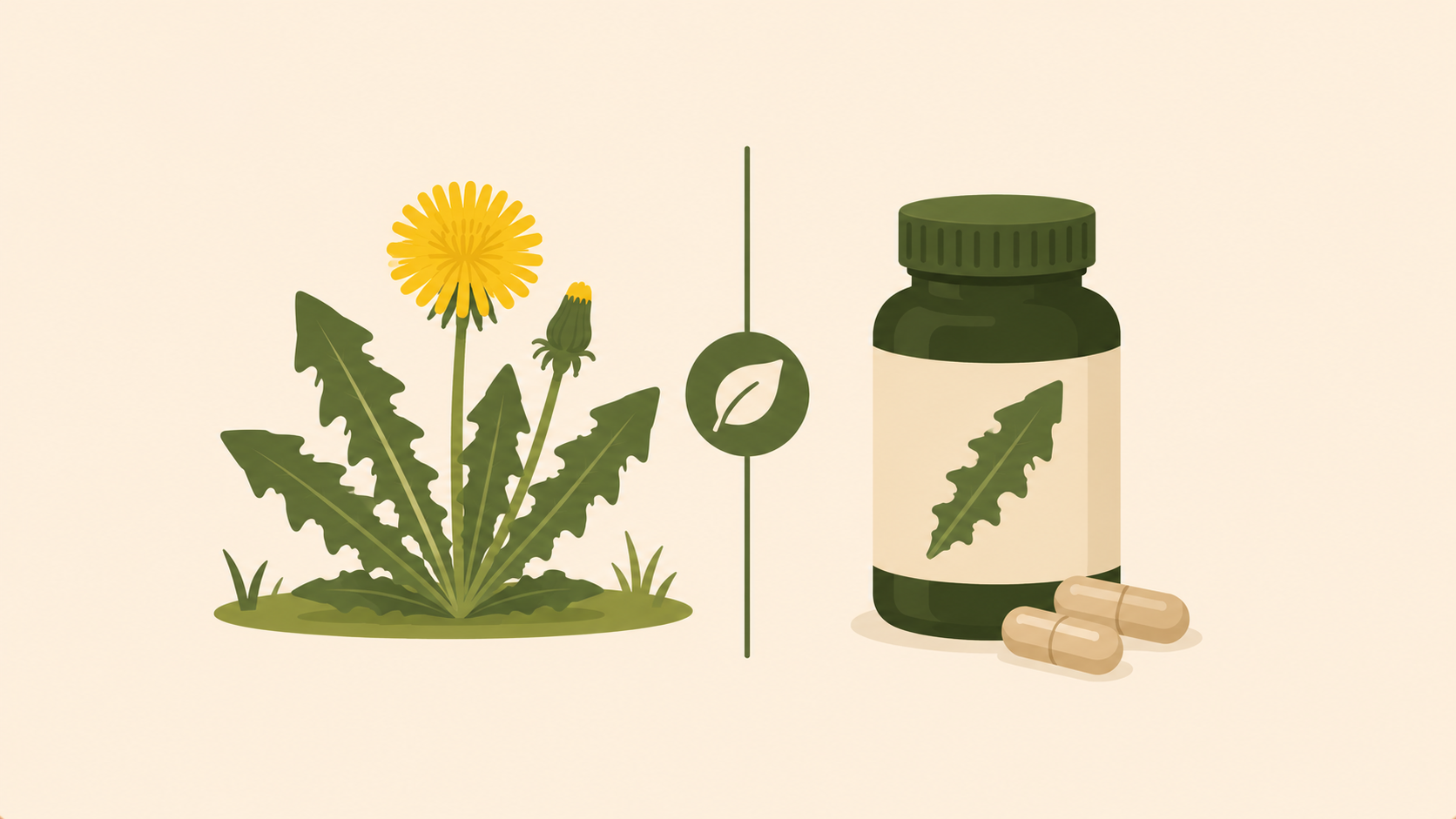
You should not treat backyard dandelion as an automatic substitute for dandelion leaf capsules. Backyard leaves may be edible if correctly identified and safely harvested, but they do not offer the same consistency, quality controls, drying standards, serving directions, or testing expectations as a commercial supplement.
The biggest concern is unknown exposure. A lawn may look natural but still carry herbicide residue, pesticide drift, pet waste, road dust, fertilizer, mold, or soil contamination.
If you cannot confirm the location is clean and untreated, do not use backyard dandelion as food or supplement material.
Quick Comparison: Backyard Dandelion vs Capsules
| Factor | Backyard Dandelion | Dandelion Leaf Capsules |
|---|---|---|
| Identity | Depends on correct plant identification | Should list botanical name on label |
| Exposure risk | May include lawn chemicals, pet waste, roadside dust, or soil contaminants | Should rely on sourcing and quality controls |
| Serving consistency | Variable leaf size, age, moisture, and preparation | Measured capsule serving |
| Preparation | Requires washing, sorting, drying, or cooking | Ready to use by label directions |
| Taste | Bitter and food-like | Mostly hidden by capsule |
| Seasonality | Depends on weather and location | Available year-round |
| Quality information | You must judge the site yourself | Label should show plant part, serving, and warnings |
Why Familiar Plants Still Need Identification
Dandelion is common, but correct identification still matters. The common dandelion is usually associated with Taraxacum officinale, but beginners may confuse similar-looking rosette plants or yellow-flowered weeds.
True dandelion leaves form a basal rosette. The flower stalk is usually hollow and leafless. The plant produces a yellow flower head and later a round seed head. Leaves are toothed and variable in shape.
Do not eat or dry wild plants unless you can identify them confidently. If you are unsure, buy food-grade greens or a clearly labeled supplement instead.
Why Lawn Chemicals Are a Real Concern
Many lawns are treated with herbicides, pesticides, fertilizers, weed-and-feed products, or chemical sprays. Even if you did not treat your yard, a previous homeowner, landlord, lawn service, neighbor, or municipal crew may have done so.
Dandelions grow low to the ground. Their leaves can collect spray residue, dust, and surface contamination.
Do not harvest from lawns that may have been treated. “It looks green” is not a safety check.
Why Dog-Walk Areas Are Not Good Harvest Sites
Dog-walk areas, parks, sidewalk strips, apartment lawns, and public green spaces are poor harvest sites. These areas may contain urine, fecal contamination, parasites, bacteria, lawn chemicals, road runoff, or trash residue.
Washing helps remove visible dirt, but it does not make every contaminated location safe.
If people regularly walk pets through an area, do not treat those dandelions as food or supplement material.
Why Roadside Dandelions Are a Bad Idea
Roadside plants can be exposed to vehicle emissions, tire particles, brake dust, oil residue, salt, heavy metals, and stormwater runoff. Dandelions near parking lots, alleys, driveways, and busy roads deserve the same caution.
Location matters as much as plant identity. A correctly identified dandelion from a contaminated place is still a poor choice.
For food or home drying, choose only clean, legal, low-risk growing areas where chemical history and exposure are known.
Wild Greens vs Supplement Capsules
| Question | Wild or Backyard Greens | Commercial Capsules |
|---|---|---|
| Do you know the plant identity? | You must verify it yourself | Label should identify it |
| Do you know contamination history? | Often uncertain | Depends on sourcing and testing |
| Can you control serving size? | Difficult to standardize | Label gives a serving |
| Can you avoid bitter taste? | No, unless cooked or mixed | Mostly yes |
| Can you store it easily? | Only if dried properly | Shelf-stable when stored as directed |
| Can you verify quality? | Mostly personal judgment | Look for testing and transparent labeling |
Why Drying Quality Matters
If someone tries to turn backyard dandelion leaves into dried material, drying quality becomes a major issue. Poor drying can trap moisture, encourage mold, create off odors, or produce uneven material.
Leaves should be clean, dry, and handled hygienically. They should not be dried in dusty garages, damp basements, pet areas, or places exposed to smoke, insects, or household chemicals.
Commercial supplements should be produced under manufacturing controls. Home drying does not automatically match that standard.
Why Serving Consistency Is Hard With Backyard Leaves
Fresh leaves vary by size, age, moisture, season, growing conditions, and harvest timing. Young spring leaves are not the same as older, tougher leaves from a hot summer lawn.
Cooking changes weight and volume. Drying removes water. Grinding changes density. These changes make it difficult to compare backyard material with a capsule serving.
A dandelion leaf capsule gives a measured serving by label directions. A handful of leaves does not translate neatly into capsule math.
What a Dandelion Leaf Capsule Label Should Show
A good dandelion leaf capsule label should show the botanical name, plant part, serving size, and warnings. Look for Taraxacum officinale, dandelion leaf, leaf powder, aerial parts, or leaf extract.
Be careful not to confuse dandelion leaf with dandelion root. Leaf and root are different plant parts and may appear in different products.
Garden Organics takes a cautious editorial stance here: a clear supplement label should make plant identity and plant part easy to verify, not hide behind broad “green cleanse” language.
What Does “Food Grade” Mean in Practice?
Food-grade greens are grown, harvested, handled, and sold for eating. This does not make them perfect, but it gives the buyer more structure than random lawn harvesting.
Grocery dandelion greens still need washing and safe food handling. But they reduce some major uncertainties, such as roadside exposure, lawn treatments, and dog-walk contamination.
If your goal is to eat dandelion greens as food, grocery or garden-grown greens from a known safe source are usually easier to justify than random backyard harvesting.
Backyard Dandelion Is Not the Same as Organic
Many people assume backyard plants are “organic” because no one is spraying them today. That assumption is weak.
Organic standards involve more than avoiding a spray bottle. They involve sourcing, production rules, land history, prohibited substances, handling, certification, and documentation.
A backyard dandelion may be untreated, but unless you know the land history and exposure, it is not the same as certified organic or professionally sourced plant material.
When Backyard Dandelion Is a Bad Idea
Backyard dandelion is a bad idea when the area may have been sprayed, fertilized, treated for weeds, exposed to pets, near roads, near parking lots, near industrial land, or affected by unknown soil history.
It is also a bad idea if you cannot identify the plant confidently, cannot dry it properly, or plan to use it like a measured supplement.
Do not harvest from public spaces unless it is legal, clean, and clearly safe. Many public areas are treated or contaminated in ways you cannot see.
When Dandelion Leaf Capsules May Be More Practical
Dandelion leaf capsules may be more practical when you want a shelf-stable product, a measured serving, taste avoidance, year-round availability, and a label with botanical identity.
Capsules are also easier for people who dislike bitter greens or do not want to forage, wash, cook, dry, and store leaves.
The trade-off is that supplements still require label reading. You should check plant part, serving size, other ingredients, warnings, quality testing, and medication cautions.
Safety Cautions for Dandelion Supplements
Dandelion supplements may not fit everyone. People with ragweed-family allergies may react to dandelion because it belongs to the Asteraceae family.
Dandelion may also matter with diuretics, lithium, blood thinners, blood pressure medications, diabetes medications, and other prescriptions. People with kidney concerns, gallbladder issues, bile duct problems, or chronic conditions should ask a qualified professional before use.
Pregnant or breastfeeding people and children should not use dandelion supplements without professional guidance.
Backyard Dandelion vs Dandelion Leaf Capsules Checklist
Use this checklist before deciding whether to use backyard dandelion leaves, grocery greens, dried leaves, tea, or dandelion leaf capsules. The goal is to separate safe food handling, foraging risk, and supplement label quality.
Confirm Plant Identification
Make sure the plant is truly dandelion and not a similar-looking weed. If you are unsure, do not harvest it.
Check Location History
Only consider plants from areas with known clean history. Avoid treated lawns, public parks, roadsides, dog-walk areas, and industrial zones.
Avoid Chemical Exposure
Do not harvest from areas exposed to herbicides, pesticides, weed-and-feed products, fertilizer runoff, or unknown lawn treatments.
Consider Pet and Wildlife Contact
Skip areas where dogs, cats, wildlife, or livestock may contaminate plants. Low-growing leaves can collect more than visible dirt.
Do Not Guess Serving Size
Fresh leaves, cooked greens, dried leaf, and capsules are different formats. Do not convert them casually.
Check Drying Conditions
If drying leaves at home, poor drying can create moisture and mold problems. Do not dry leaves in dirty, damp, or chemical-exposed spaces.
Read Capsule Labels Carefully
Look for Taraxacum officinale, dandelion leaf, plant part, serving size, warnings, and other ingredients.
Review Medication Cautions
Ask a professional if you take diuretics, lithium, blood thinners, blood pressure drugs, diabetes medications, or other prescriptions.
Choose the Safer Format
If the backyard source is uncertain, choose grocery greens or a transparent supplement instead of guessing.
Common Mistakes to Avoid
Assuming Backyard Means Clean
A plant can look healthy and still be exposed to chemicals, pet waste, road dust, or contaminated soil.
Confusing Familiar With Safe
Dandelion is common, but correct identification and clean sourcing still matter.
Using Lawn Plants Like Supplements
Random leaves do not provide measured serving consistency or label-based quality information.
Drying Leaves Carelessly
Poor drying can create mold, moisture, and storage problems.
Ignoring Medication Context
Dandelion supplements can matter with certain medications and health conditions. Ask when risk factors apply.
FAQ
Can I use backyard dandelion instead of dandelion leaf capsules?
Not automatically. Backyard dandelions may be exposed to chemicals, pet waste, roadside pollution, or misidentification risk.
Are backyard dandelions safe to eat?
Only if correctly identified and harvested from a clean, untreated, legal, and low-risk area.
Are dandelion leaf capsules safer than foraging?
They reduce some foraging risks, but buyers still need to check label clarity, sourcing, testing, warnings, and medication cautions.
Can I harvest dandelions from my lawn?
Avoid lawn harvest unless you know the full treatment history and the area is free from pets, chemicals, runoff, and contamination.
Why are roadside dandelions risky?
Roadside plants may be exposed to vehicle residue, tire dust, oil, salt, runoff, and other contaminants.
Can I dry my own dandelion leaves?
You can only consider it if the leaves are correctly identified, cleanly harvested, washed, and dried under hygienic conditions.
Is dandelion leaf the same as dandelion root?
No. Leaf and root are different plant parts and should be checked separately on supplement labels.
What should a capsule label show?
Look for botanical name, plant part, serving size, other ingredients, warnings, and quality information.
Who should ask a professional before using dandelion supplements?
Medication users, pregnant or breastfeeding people, children, and people with kidney, gallbladder, bile duct, allergy, blood pressure, blood sugar, or chronic health concerns should ask first.
Glossary
Backyard Dandelion
Dandelion plants growing in a private yard, lawn, garden, or nearby outdoor area.
Dandelion Leaf Capsules
Capsules that usually contain dried dandelion leaf powder or leaf extract.
Taraxacum officinale
The botanical name commonly associated with common dandelion.
Foraging
Gathering wild or outdoor-growing plants for food or personal use.
Plant Identification
The process of confirming a plant’s identity before harvesting or using it.
Food Grade
A practical term for material handled and sold for eating under food-use expectations.
Supplement Facts
The label panel that lists serving size and dietary ingredient information for a supplement.
Plant Part
The specific part used, such as leaf, root, aerial parts, or whole plant.
Contamination
Unwanted exposure to chemicals, microbes, pollutants, pet waste, or other unsafe material.
Serving Consistency
The ability to use a similar measured amount each time, usually easier with labeled products than random harvested leaves.
Conclusion
Backyard Dandelion vs Dandelion Leaf Capsules comes down to control: backyard plants may look free and familiar, but they carry identification, contamination, drying, and serving-size uncertainties. Capsules are not perfect, but a transparent label can offer more consistency than random foraging.
Sources
Dandelion plant overview, edible leaves, and botanical background, Encyclopaedia Britannica — britannica.com/plant/dandelion
Dandelion greens food profile and potassium context, WebMD — webmd.com/diet/benefits-of-dandelion-greens
Dandelion supplement overview and medication safety cautions, WebMD — webmd.com/vitamins-supplements/dandelion
Dandelion safety overview including allergy and medication cautions, Mount Sinai Health Library — mountsinai.org/health-library/herb/dandelion
Food safety guidance for selecting, washing, and serving produce safely, U.S. Food and Drug Administration — fda.gov/food/buy-store-serve-safe-food/selecting-and-serving-produce-safely
Guidance on wild food foraging safety and avoiding polluted or treated areas, University of Minnesota Extension — extension.umn.edu
Foraging safety guidance including identification and contamination cautions, Penn State Extension — extension.psu.edu
Dietary supplement consumer guidance and label-reading basics, U.S. Food and Drug Administration — fda.gov/food/information-consumers-using-dietary-supplements/questions-and-answers-dietary-supplements
Supplement Facts label and serving-size guidance, U.S. Food and Drug Administration — fda.gov/food/dietary-supplements-guidance-documents-regulatory-information/dietary-supplement-labeling-guide-chapter-iv-nutrition-labelingBackyard Dandelion vs Dandelion Leaf Capsules is a practical question because dandelion feels familiar. It grows in lawns, parks, sidewalk cracks, gardens, and wild patches, so it is easy to think, “Why buy dandelion leaf capsules if I already have dandelions outside?” The answer is simple: a backyard plant and a commercial supplement are not the same product.
Dandelion leaves can be edible when correctly identified and gathered from a clean, safe location. But backyard dandelions may also be exposed to herbicides, pesticides, dog-walk areas, roadside pollution, lawn treatments, contaminated soil, or misidentification risk. Dandelion leaf capsules are different because they are dried, processed, measured, packaged, and labeled as a supplement. Garden Organics treats this as a sourcing and safety-literacy topic: familiar plants still require careful handling.
This article does not provide medical advice. Dandelion leaf products are not intended to diagnose, treat, cure, or prevent any disease. If you are pregnant or breastfeeding, under 18, taking medication, using diuretics, taking lithium, managing kidney disease, gallbladder issues, bile duct issues, blood sugar concerns, blood pressure concerns, ragweed-family allergies, or chronic health conditions, ask a qualified healthcare professional before using dandelion supplements.
Can You Use Backyard Dandelion Instead of Dandelion Leaf Capsules?
You should not treat backyard dandelion as an automatic substitute for dandelion leaf capsules. Backyard leaves may be edible if correctly identified and safely harvested, but they do not offer the same consistency, quality controls, drying standards, serving directions, or testing expectations as a commercial supplement.
The biggest concern is unknown exposure. A lawn may look natural but still carry herbicide residue, pesticide drift, pet waste, road dust, fertilizer, mold, or soil contamination.
If you cannot confirm the location is clean and untreated, do not use backyard dandelion as food or supplement material.
Quick Comparison: Backyard Dandelion vs Capsules
| Factor | Backyard Dandelion | Dandelion Leaf Capsules |
|---|---|---|
| Identity | Depends on correct plant identification | Should list botanical name on label |
| Exposure risk | May include lawn chemicals, pet waste, roadside dust, or soil contaminants | Should rely on sourcing and quality controls |
| Serving consistency | Variable leaf size, age, moisture, and preparation | Measured capsule serving |
| Preparation | Requires washing, sorting, drying, or cooking | Ready to use by label directions |
| Taste | Bitter and food-like | Mostly hidden by capsule |
| Seasonality | Depends on weather and location | Available year-round |
| Quality information | You must judge the site yourself | Label should show plant part, serving, and warnings |
Why Familiar Plants Still Need Identification
Dandelion is common, but correct identification still matters. The common dandelion is usually associated with Taraxacum officinale, but beginners may confuse similar-looking rosette plants or yellow-flowered weeds.
True dandelion leaves form a basal rosette. The flower stalk is usually hollow and leafless. The plant produces a yellow flower head and later a round seed head. Leaves are toothed and variable in shape.
Do not eat or dry wild plants unless you can identify them confidently. If you are unsure, buy food-grade greens or a clearly labeled supplement instead.
Why Lawn Chemicals Are a Real Concern
Many lawns are treated with herbicides, pesticides, fertilizers, weed-and-feed products, or chemical sprays. Even if you did not treat your yard, a previous homeowner, landlord, lawn service, neighbor, or municipal crew may have done so.
Dandelions grow low to the ground. Their leaves can collect spray residue, dust, and surface contamination.
Do not harvest from lawns that may have been treated. “It looks green” is not a safety check.
Why Dog-Walk Areas Are Not Good Harvest Sites
Dog-walk areas, parks, sidewalk strips, apartment lawns, and public green spaces are poor harvest sites. These areas may contain urine, fecal contamination, parasites, bacteria, lawn chemicals, road runoff, or trash residue.
Washing helps remove visible dirt, but it does not make every contaminated location safe.
If people regularly walk pets through an area, do not treat those dandelions as food or supplement material.
Why Roadside Dandelions Are a Bad Idea
Roadside plants can be exposed to vehicle emissions, tire particles, brake dust, oil residue, salt, heavy metals, and stormwater runoff. Dandelions near parking lots, alleys, driveways, and busy roads deserve the same caution.
Location matters as much as plant identity. A correctly identified dandelion from a contaminated place is still a poor choice.
For food or home drying, choose only clean, legal, low-risk growing areas where chemical history and exposure are known.
Wild Greens vs Supplement Capsules
| Question | Wild or Backyard Greens | Commercial Capsules |
|---|---|---|
| Do you know the plant identity? | You must verify it yourself | Label should identify it |
| Do you know contamination history? | Often uncertain | Depends on sourcing and testing |
| Can you control serving size? | Difficult to standardize | Label gives a serving |
| Can you avoid bitter taste? | No, unless cooked or mixed | Mostly yes |
| Can you store it easily? | Only if dried properly | Shelf-stable when stored as directed |
| Can you verify quality? | Mostly personal judgment | Look for testing and transparent labeling |
Why Drying Quality Matters
If someone tries to turn backyard dandelion leaves into dried material, drying quality becomes a major issue. Poor drying can trap moisture, encourage mold, create off odors, or produce uneven material.
Leaves should be clean, dry, and handled hygienically. They should not be dried in dusty garages, damp basements, pet areas, or places exposed to smoke, insects, or household chemicals.
Commercial supplements should be produced under manufacturing controls. Home drying does not automatically match that standard.
Why Serving Consistency Is Hard With Backyard Leaves
Fresh leaves vary by size, age, moisture, season, growing conditions, and harvest timing. Young spring leaves are not the same as older, tougher leaves from a hot summer lawn.
Cooking changes weight and volume. Drying removes water. Grinding changes density. These changes make it difficult to compare backyard material with a capsule serving.
A dandelion leaf capsule gives a measured serving by label directions. A handful of leaves does not translate neatly into capsule math.
What a Dandelion Leaf Capsule Label Should Show
A good dandelion leaf capsule label should show the botanical name, plant part, serving size, and warnings. Look for Taraxacum officinale, dandelion leaf, leaf powder, aerial parts, or leaf extract.
Be careful not to confuse dandelion leaf with dandelion root. Leaf and root are different plant parts and may appear in different products.
Garden Organics takes a cautious editorial stance here: a clear supplement label should make plant identity and plant part easy to verify, not hide behind broad “green cleanse” language.
What Does “Food Grade” Mean in Practice?
Food-grade greens are grown, harvested, handled, and sold for eating. This does not make them perfect, but it gives the buyer more structure than random lawn harvesting.
Grocery dandelion greens still need washing and safe food handling. But they reduce some major uncertainties, such as roadside exposure, lawn treatments, and dog-walk contamination.
If your goal is to eat dandelion greens as food, grocery or garden-grown greens from a known safe source are usually easier to justify than random backyard harvesting.
Backyard Dandelion Is Not the Same as Organic
Many people assume backyard plants are “organic” because no one is spraying them today. That assumption is weak.
Organic standards involve more than avoiding a spray bottle. They involve sourcing, production rules, land history, prohibited substances, handling, certification, and documentation.
A backyard dandelion may be untreated, but unless you know the land history and exposure, it is not the same as certified organic or professionally sourced plant material.
When Backyard Dandelion Is a Bad Idea
Backyard dandelion is a bad idea when the area may have been sprayed, fertilized, treated for weeds, exposed to pets, near roads, near parking lots, near industrial land, or affected by unknown soil history.
It is also a bad idea if you cannot identify the plant confidently, cannot dry it properly, or plan to use it like a measured supplement.
Do not harvest from public spaces unless it is legal, clean, and clearly safe. Many public areas are treated or contaminated in ways you cannot see.
When Dandelion Leaf Capsules May Be More Practical
Dandelion leaf capsules may be more practical when you want a shelf-stable product, a measured serving, taste avoidance, year-round availability, and a label with botanical identity.
Capsules are also easier for people who dislike bitter greens or do not want to forage, wash, cook, dry, and store leaves.
The trade-off is that supplements still require label reading. You should check plant part, serving size, other ingredients, warnings, quality testing, and medication cautions.
Safety Cautions for Dandelion Supplements
Dandelion supplements may not fit everyone. People with ragweed-family allergies may react to dandelion because it belongs to the Asteraceae family.
Dandelion may also matter with diuretics, lithium, blood thinners, blood pressure medications, diabetes medications, and other prescriptions. People with kidney concerns, gallbladder issues, bile duct problems, or chronic conditions should ask a qualified professional before use.
Pregnant or breastfeeding people and children should not use dandelion supplements without professional guidance.
Backyard Dandelion vs Dandelion Leaf Capsules Checklist
Use this checklist before deciding whether to use backyard dandelion leaves, grocery greens, dried leaves, tea, or dandelion leaf capsules. The goal is to separate safe food handling, foraging risk, and supplement label quality.
Confirm Plant Identification
Make sure the plant is truly dandelion and not a similar-looking weed. If you are unsure, do not harvest it.
Check Location History
Only consider plants from areas with known clean history. Avoid treated lawns, public parks, roadsides, dog-walk areas, and industrial zones.
Avoid Chemical Exposure
Do not harvest from areas exposed to herbicides, pesticides, weed-and-feed products, fertilizer runoff, or unknown lawn treatments.
Consider Pet and Wildlife Contact
Skip areas where dogs, cats, wildlife, or livestock may contaminate plants. Low-growing leaves can collect more than visible dirt.
Do Not Guess Serving Size
Fresh leaves, cooked greens, dried leaf, and capsules are different formats. Do not convert them casually.
Check Drying Conditions
If drying leaves at home, poor drying can create moisture and mold problems. Do not dry leaves in dirty, damp, or chemical-exposed spaces.
Read Capsule Labels Carefully
Look for Taraxacum officinale, dandelion leaf, plant part, serving size, warnings, and other ingredients.
Review Medication Cautions
Ask a professional if you take diuretics, lithium, blood thinners, blood pressure drugs, diabetes medications, or other prescriptions.
Choose the Safer Format
If the backyard source is uncertain, choose grocery greens or a transparent supplement instead of guessing.
Common Mistakes to Avoid
Assuming Backyard Means Clean
A plant can look healthy and still be exposed to chemicals, pet waste, road dust, or contaminated soil.
Confusing Familiar With Safe
Dandelion is common, but correct identification and clean sourcing still matter.
Using Lawn Plants Like Supplements
Random leaves do not provide measured serving consistency or label-based quality information.
Drying Leaves Carelessly
Poor drying can create mold, moisture, and storage problems.
Ignoring Medication Context
Dandelion supplements can matter with certain medications and health conditions. Ask when risk factors apply.
FAQ
Can I use backyard dandelion instead of dandelion leaf capsules?
Not automatically. Backyard dandelions may be exposed to chemicals, pet waste, roadside pollution, or misidentification risk.
Are backyard dandelions safe to eat?
Only if correctly identified and harvested from a clean, untreated, legal, and low-risk area.
Are dandelion leaf capsules safer than foraging?
They reduce some foraging risks, but buyers still need to check label clarity, sourcing, testing, warnings, and medication cautions.
Can I harvest dandelions from my lawn?
Avoid lawn harvest unless you know the full treatment history and the area is free from pets, chemicals, runoff, and contamination.
Why are roadside dandelions risky?
Roadside plants may be exposed to vehicle residue, tire dust, oil, salt, runoff, and other contaminants.
Can I dry my own dandelion leaves?
You can only consider it if the leaves are correctly identified, cleanly harvested, washed, and dried under hygienic conditions.
Is dandelion leaf the same as dandelion root?
No. Leaf and root are different plant parts and should be checked separately on supplement labels.
What should a capsule label show?
Look for botanical name, plant part, serving size, other ingredients, warnings, and quality information.
Who should ask a professional before using dandelion supplements?
Medication users, pregnant or breastfeeding people, children, and people with kidney, gallbladder, bile duct, allergy, blood pressure, blood sugar, or chronic health concerns should ask first.
Glossary
Backyard Dandelion
Dandelion plants growing in a private yard, lawn, garden, or nearby outdoor area.
Dandelion Leaf Capsules
Capsules that usually contain dried dandelion leaf powder or leaf extract.
Taraxacum officinale
The botanical name commonly associated with common dandelion.
Foraging
Gathering wild or outdoor-growing plants for food or personal use.
Plant Identification
The process of confirming a plant’s identity before harvesting or using it.
Food Grade
A practical term for material handled and sold for eating under food-use expectations.
Supplement Facts
The label panel that lists serving size and dietary ingredient information for a supplement.
Plant Part
The specific part used, such as leaf, root, aerial parts, or whole plant.
Contamination
Unwanted exposure to chemicals, microbes, pollutants, pet waste, or other unsafe material.
Serving Consistency
The ability to use a similar measured amount each time, usually easier with labeled products than random harvested leaves.
Conclusion
Backyard Dandelion vs Dandelion Leaf Capsules comes down to control: backyard plants may look free and familiar, but they carry identification, contamination, drying, and serving-size uncertainties. Capsules are not perfect, but a transparent label can offer more consistency than random foraging.
Sources
Dandelion plant overview, edible leaves, and botanical background, Encyclopaedia Britannica — britannica.com/plant/dandelion
Dandelion greens food profile and potassium context, WebMD — webmd.com/diet/benefits-of-dandelion-greens
Dandelion supplement overview and medication safety cautions, WebMD — webmd.com/vitamins-supplements/dandelion
Dandelion safety overview including allergy and medication cautions, Mount Sinai Health Library — mountsinai.org/health-library/herb/dandelion
Food safety guidance for selecting, washing, and serving produce safely, U.S. Food and Drug Administration — fda.gov/food/buy-store-serve-safe-food/selecting-and-serving-produce-safely
Guidance on wild food foraging safety and avoiding polluted or treated areas, University of Minnesota Extension — extension.umn.edu
Foraging safety guidance including identification and contamination cautions, Penn State Extension — extension.psu.edu
Dietary supplement consumer guidance and label-reading basics, U.S. Food and Drug Administration — fda.gov/food/information-consumers-using-dietary-supplements/questions-and-answers-dietary-supplements
Supplement Facts label and serving-size guidance, U.S. Food and Drug Administration — fda.gov/food/dietary-supplements-guidance-documents-regulatory-information/dietary-supplement-labeling-guide-chapter-iv-nutrition-labeling