
Bet Tracker vs. Spreadsheet: Which Is Better for Managing Your Bets?
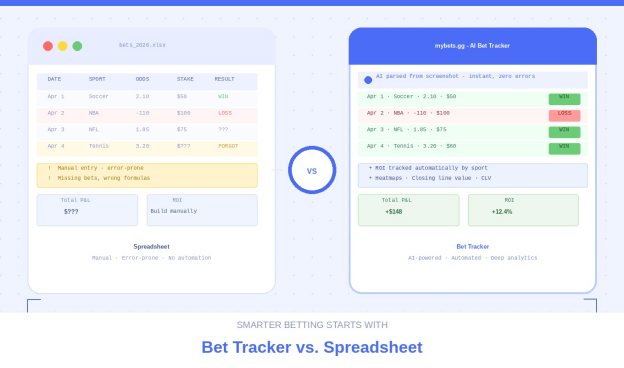
Every serious bettor reaches a turning point. You’ve placed enough bets to know gut feeling alone won’t cut it. You start thinking about tracking — recording your wins, losses, stakes, and returns so you can actually see what’s working and what isn’t. The question most bettors face at that moment is the same: do I build a spreadsheet, or do I use a dedicated bet tracker?
Both options have their fans. But once you understand what each one actually does — and doesn’t do — the answer becomes pretty clear. This guide breaks down the real differences so you can make a smarter decision for your betting bankroll.
What Is a Bet Tracker?
A bet tracker is a dedicated tool — usually an app or web platform — built specifically to log, organize, and analyze your betting activity. Unlike a general-purpose spreadsheet, a bet tracker is designed from the ground up with bettors in mind. It understands bet types, odds formats, sportsbooks, stakes, and ROI calculations natively, without you having to build any of that logic yourself.
Modern bet trackers go even further by using AI to automate the data entry process entirely. Instead of typing in every bet manually, you can upload a screenshot of your betslip or use a browser extension that captures your bet directly from any sportsbook — and the platform logs everything instantly.
The Case for Spreadsheets
Spreadsheets have been the go-to bet tracking method for years, and it’s easy to see why. They’re free, familiar, and infinitely flexible. If you know your way around Excel or Google Sheets, you can build custom formulas, color-coded dashboards, and even basic charts that visualize your profit and loss over time.
For casual bettors placing a handful of wagers per week, a spreadsheet is perfectly functional. You control the structure completely, and there’s no learning curve if you’re already comfortable with the tools.
But the cracks start to show the moment your betting volume increases or your strategy becomes more complex. That’s when spreadsheets go from convenient to costly.
Where Spreadsheets Fall Short
Manual entry is slow and error-prone. Every bet has to be typed in by hand — the sport, the market, the odds, the stake, the outcome. Miss a decimal, enter the wrong odds format, or forget to log a bet entirely, and your data becomes unreliable. Decisions based on bad data are worse than making no data-driven decisions at all.
No real-time insights. A spreadsheet shows you what happened, not why. It can’t tell you that you’re consistently losing value on Tuesday night NFL games, or that your win rate on soccer overs drops by 18% when you bet on away teams. Surfacing those patterns requires the kind of advanced analytics that spreadsheets simply weren’t built to deliver.
Zero automation. Every update is a manual task. If you’re betting across multiple sportsbooks, you’re maintaining multiple sheets, reconciling data manually, and spending hours each week on admin instead of strategy.
No collaboration. If you bet as part of a syndicate or group, spreadsheets become messy fast. Shared access, version conflicts, and no audit trail make group betting with spreadsheets a logistical headache.
What a Dedicated Bet Tracker Gets Right
A purpose-built bet tracker solves every one of those problems — and then some.
Automated logging. Platforms use AI-powered screenshot parsing and a browser extension to capture your bets in seconds. There’s no manual entry, no transcription errors, and no time wasted. The bet tracker does the work for you.
Deep analytics out of the box. Real bet trackers give you ROI by sport, by bet type, by sportsbook, and by time period. You can see your closing line value, identify your strongest and weakest markets, and track your bankroll growth with interactive charts and heatmaps — all without building a single formula.
Bankroll management built in. Knowing your total exposure, your unit sizes, and your running P&L at any moment is critical for staying disciplined. A proper bet tracker keeps all of that updated automatically.
Group vaults for syndicates. If you bet collaboratively, tools like mybets.gg let you pool bankrolls, vote on picks, and track group performance transparently — something no shared spreadsheet can replicate cleanly.
Understanding these distinctions is just as important as understanding broader betting strategy. If you’re still learning the fundamentals of smart wagering, it’s worth reading up on how to maximize bonuses and sweepstakes credits and how profitable betting differs from simply backing famous teams — both of which tie directly into why tracking your results matters so much.
Head-to-Head Comparison
| Feature | Spreadsheet | Bet Tracker (mybets.gg) |
| Cost | Free | Free tier available |
| Setup time | Hours | Minutes |
| Data entry | Manual | AI-automated |
| Analytics depth | Basic | Advanced + heatmaps |
| Bankroll tracking | Manual formulas | Automatic |
| Multi-sportsbook support | Manual | Built-in |
| Group/syndicate betting | Clunky | Native support |
| Error risk | High | Minimal |
| Mobile access | Limited | Full app access |
So Which One Should You Use?
If you place fewer than 10 bets a month and just want a basic log, a spreadsheet will do the job. But if you’re serious about improving your results, identifying your edge, and treating betting like the data-driven discipline it is — a dedicated bet tracker is not optional, it’s essential.
The best bettors don’t rely on memory or instinct alone. They track everything, analyze the patterns, and adjust their strategy based on real evidence. A modern bet tracker makes that process faster, smarter, and more accurate than any spreadsheet ever could.
Stop maintaining rows and columns. Start making data work for you.